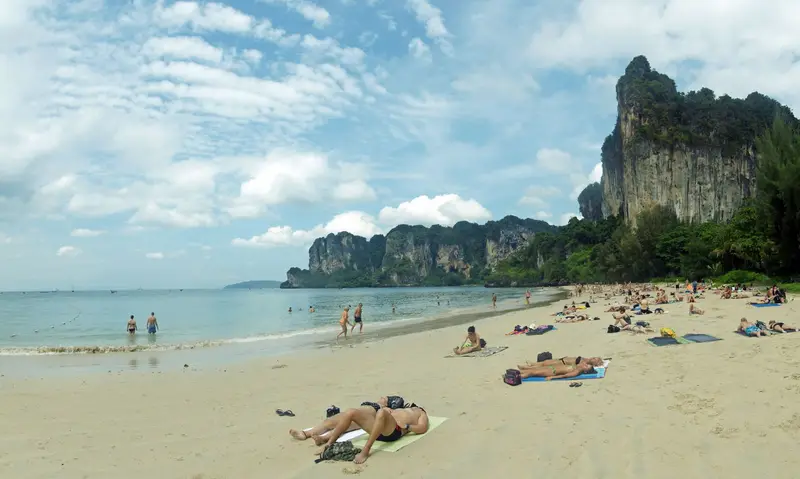

Thailand’s beaches sit on two seas: the Andaman Sea in the west and the Gulf of Thailand in the east. Their seasons differ because different monsoons bring the rain. Below are Thai Meteorological Department (TMD) normals for beach stations, what they mean for choosing a month, and where to find our area and beach guides. Checked on 17 October 2026.
Why the two seas have different seasons
TMD describes the southwest monsoon as blowing from May to October and bringing rain to windward coasts, and the northeast monsoon as blowing from October to February. TMD splits the south into two coasts: the western Andaman coast gets wet in the southwest monsoon, the eastern Gulf coast in the northeast monsoon, which picks up moisture over the Gulf. TMD notes that the south is the only region with heavy rain almost all year, around 2,300 mm. Pattaya and Hua Hin lie further north in the upper Gulf and get roughly half that: about 940-1,110 mm a year.
Beach regions by season: TMD normals
These are 1991-2020 normals. Khao Lak uses the Takua Pa station, Koh Chang the Trad station on the mainland, and Koh Phangan and Koh Tao the nearest station on Koh Samui, since TMD has no normals for those islands.
| Region | TMD station | Driest month | Wettest month | Months under 100 mm | Year, mm |
|---|---|---|---|---|---|
| Phuket | Phuket | February, 24 mm | September, 350 mm | December-March | 2,272 |
| Krabi | Krabi | February, 36 mm | October, 293 mm | December-February | 2,181 |
| Khao Lak | Takua Pa | February, 45 mm | September, 636 mm | December-February | 3,873 |
| Koh Samui, Phangan, Tao | Ko Samui | February, 64 mm | November, 445 mm | February, April (February-September all under 135 mm) | 1,994 |
| Pattaya | Phatthaya | December, 12 mm | October, 225 mm | November-April, August | 1,106 |
| Hua Hin | Hua Hin | December, 12 mm | October, 250 mm | all except September and October | 936 |
| Koh Chang | Trad | December, 28 mm | July, 1,024 mm | November-February | 4,927 |
TMD counts any day with 0.1 mm or more as a rainy day, so a sunny day with a short shower counts too. A normal is a 30-year average, and any single year can be drier or wetter.
The Andaman Sea: Phuket, Krabi, Khao Lak
The season runs from December to March: little rain, a calm sea and the national parks open. From May to October west-facing beaches get waves and red flags: Rawai municipality warns of strong waves at Nai Harn from May to October, and Karon municipality describes Karon’s waves as fairly strong. The Similan Islands close every year from 16 May to 14 October, and Maya Bay on Phi Phi from 1 August to 30 September (DNP).
Phuket. West coast beaches by area: Patong, Karon, Kata and the separate Kata Beach guide, Kamala, Surin, Bang Tao, Layan, Mai Khao by the airport, and in the south Nai Harn and Rawai, whose beach is not for swimming. Calmer spots in the rainy season are in calm beaches in Phuket, and the surrounding islands on Phuket islands.
Krabi. Driest in February, wettest in October. The trip from Phuket is on Krabi, and Phi Phi belongs to a Krabi province national park: Phi Phi.
Khao Lak. The wettest place in the table: 3,873 mm a year at Takua Pa and 636 mm in September. December to February is dry, though, and the Similan Islands are nearby. The area guide is Khao Lak.
Southern Gulf: Koh Samui, Koh Phangan, Koh Tao
The seasons are shifted here. At the Samui station February to September each get 64-134 mm, and the rains peak in October-December: 295, 445 and 263 mm. TMD’s 2026-2027 outlook expects heavy rain and 2-4 m waves on the southern Gulf coast, from Chumphon southwards, from mid-October to early January, with possible tropical storms in November and December. In summer, when Phuket has waves, Samui is usually calmer, which is the main case for these islands from May to September.
Upper and eastern Gulf: Pattaya, Hua Hin, Koh Chang
Pattaya. Dry from November to April, wettest in September and October. Beaches by area: Jomtien, Na Jomtien, Pratumnak, Wongamat, Naklua, Central Pattaya. By month: Pattaya in October and Pattaya in November.
Hua Hin. The driest beach station in the table: 936 mm a year, with more than 100 mm only in September and October. We do not have a Hua Hin guide yet.
Koh Chang. Use the Trad station on the mainland as a guide, as TMD has no normals for the island. The seasons are sharp: dry from November to February, over 1,000 mm in July. Not a summer beach destination.
Beach holidays by month: a quick guide
| Months | Where, by TMD normals | What to avoid |
|---|---|---|
| December-March | Phuket, Krabi, Khao Lak, Pattaya, Hua Hin, Koh Chang until February | Samui is still wet in December and January |
| April | every region | heat: highs from 31.8 °C on Samui to 34.3 °C in Krabi |
| May-September | Koh Samui, Phangan, Tao, Hua Hin | the Andaman coast and Koh Chang |
| October | Hua Hin and Pattaya, with caveats | Samui, the Andaman coast until mid-month |
| November | Pattaya, Hua Hin, the Andaman coast towards the end of the month | Samui, Phangan, Tao |
Month-by-month guides: Thailand in October, Thailand in November, Phuket in October, Phuket in February. If you are choosing between the two main resorts, see Pattaya vs Phuket.
FAQ
What is the prettiest beach in Thailand?
There is no objective ranking, and travel top-tens differ from site to site. We compare beaches on checkable points: season by TMD normals, waves as described by municipalities, distance to the airport and what is nearby. That makes choosing easier than going by photos.
Where is the best beach holiday in Thailand?
It depends on the month. From December to March the Andaman coast is driest by TMD normals: Phuket, Krabi, Khao Lak. From May to September Koh Samui and nearby islands are better, with under 135 mm a month. Pattaya and Hua Hin are driest from November to April and closest to Bangkok.
Where is the sea calm in Thailand in summer?
From May to October the southwest monsoon brings waves to the Andaman coast. The Gulf of Thailand is calmer then: Koh Samui gets 102-134 mm a month from May to September by TMD normals. Phuket also has bays on its east coast sheltered from the west wind.
Which Thai beaches have white sand?
There is no official register of beaches by sand colour. Municipalities describe their beaches in their own words: Rawai municipality, for example, mentions Nai Harn's fine sand. Our area pages collect these official descriptions for each beach.
Which beach is Bangla Road on?
Bangla Road is in Patong and runs down to Patong Beach on Phuket's west coast. It is the island's main nightlife street, so staying right next to it is noisy. More on the Patong page.
Sources
- TMD. Climatological Data for the Period 1991-2020 (stations 48 461, 48 475, 48 501, 48 550, 48 561, 48 563, 48 564, 48 565)
- TMD. Thailand's seasons and climate, PDF pp. 2, 4, 6
- TMD. Cool season outlook 2026-2027 (issued 9 October 2026)
- DNP. Mu Ko Similan National Park
- DNP. National park closures 2569 (2026)
- Rawai Municipality. Nai Harn Beach
- Karon Municipality. Karon Beach
Found an error or outdated fact? Tell the editors, we will fix it and update the check date.