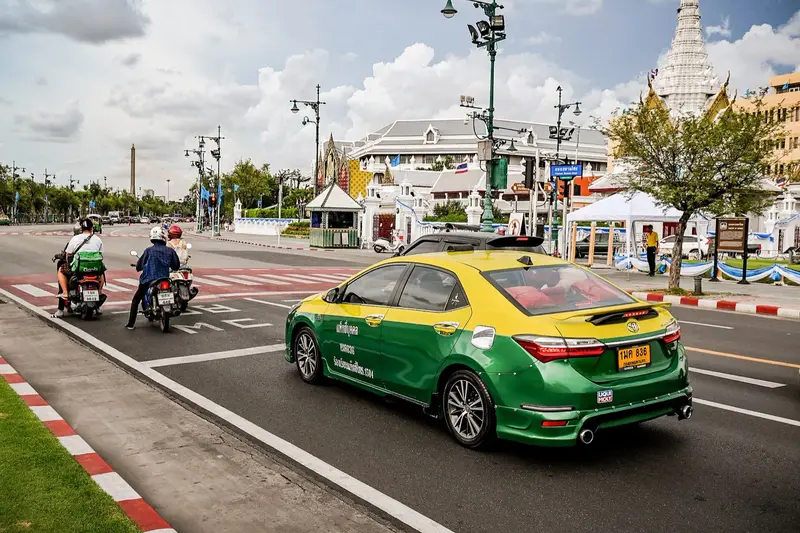

Thailand’s road rules come from two laws: the Land Traffic Act B.E. 2522 (1979) and the Motor Vehicle Act of the same year, which covers licences. This guide sets out what they say as of 17 October 2026, with section numbers, based on the official Thai texts in the Office of the Council of State database. Where something is drivers’ experience rather than law, we say so.
Driving on the left: what catches people out
Section 33 requires you to keep left and not cross the middle of the road. Cars are right-hand drive and the indicator stalk is often on the right too, so newcomers tend to switch on the wipers when they mean to signal. The tricky moments:
- Right turns. This is the turn across oncoming traffic. At a junction let oncoming vehicles going straight through first, then turn (Section 51)
- U-turns. Banned at junctions unless a sign allows it, on bridges and within 100 m of a bridge approach, and wherever a no U-turn sign stands (Section 53). With another vehicle within 100 m, turn only if it is safe and blocks no one (Section 52). On divided roads you turn at dedicated gaps in the median, which can be a few kilometres away
- Multi-lane roads. The law tells you to stay in the leftmost lane and use the others to overtake or turn (Section 34). Motorbikes usually ride on the left along the kerb and filter past cars, so check your left mirror before turning left
- Roundabouts. Go round clockwise, keeping the island on your right (Section 51). Where there are no signs or lights, give way to traffic already on the roundabout coming from your right (Section 73)
Crossing the centre without a reason the law accepts costs up to 2,000 baht (Section 151). The same fine applies to hogging the right-hand lanes.
Which licence you need in Thailand
Section 42 of the Motor Vehicle Act requires drivers to carry their licence and a copy of the vehicle’s registration book (on a rental scooter it is usually under the seat or with the owner). A foreigner here temporarily may drive on their own licence in the categories it shows, provided they follow the international agreements, in practice the road traffic conventions (Sections 42 and 42 bis).
| What you hold | Car | Scooter or motorbike |
|---|---|---|
| Licence with category B and an IDP | yes | no |
| Licence with categories A and B and an IDP | yes | yes |
| Thai car licence | yes | no |
| Thai motorcycle licence | no | yes |
| No licence | no, fine up to 1,000 baht | no, fine up to 1,000 baht |
1949 or 1968 IDP
Thailand acceded to the 1949 Geneva Convention on 15 August 1962 and ratified the 1968 Vienna Convention on 1 May 2020; it entered into force for Thailand exactly a year later, on 1 May 2021 (Article 47 of the convention, UN data). On ratifying, it declared that it treats mopeds as motorcycles, so any scooter needs category A. That history explains the confusion: before 1 May 2021 only the Geneva convention applied for Thailand, and older advice says Thailand accepts only the 1949 IDP. The UK government now tells its citizens to carry the 1968 IDP in Thailand alongside their UK licence. The simple rule: get the IDP for the convention your country belongs to, and the 1968 version if it belongs to both. More on scooters and category A in which licence you need for a scooter.
Getting a Thai licence
Thai licences are issued by the Department of Land Transport (DLT). Book ahead through the DLT Smart Queue app or gecc.dlt.go.th. A foreigner needs a passport, a residence certificate or a work permit showing an address, and a medical certificate issued no more than 1 month before applying. The DLT process then runs in this order:
- Document check and application
- Tests for colour vision, depth and field of vision and foot reaction on the brake
- Training of at least 5 hours
- Computer-based theory test
- Practical test on a course: for motorcycles a narrow plank, a slalom, tight turns and obstacle avoidance
- Fee payment before 15:30, photo and licence issue
A tourist without a residence certificate or work permit cannot apply this way, so for a holiday it is more realistic to get the right category at home.
Helmets, seat belts and child seats
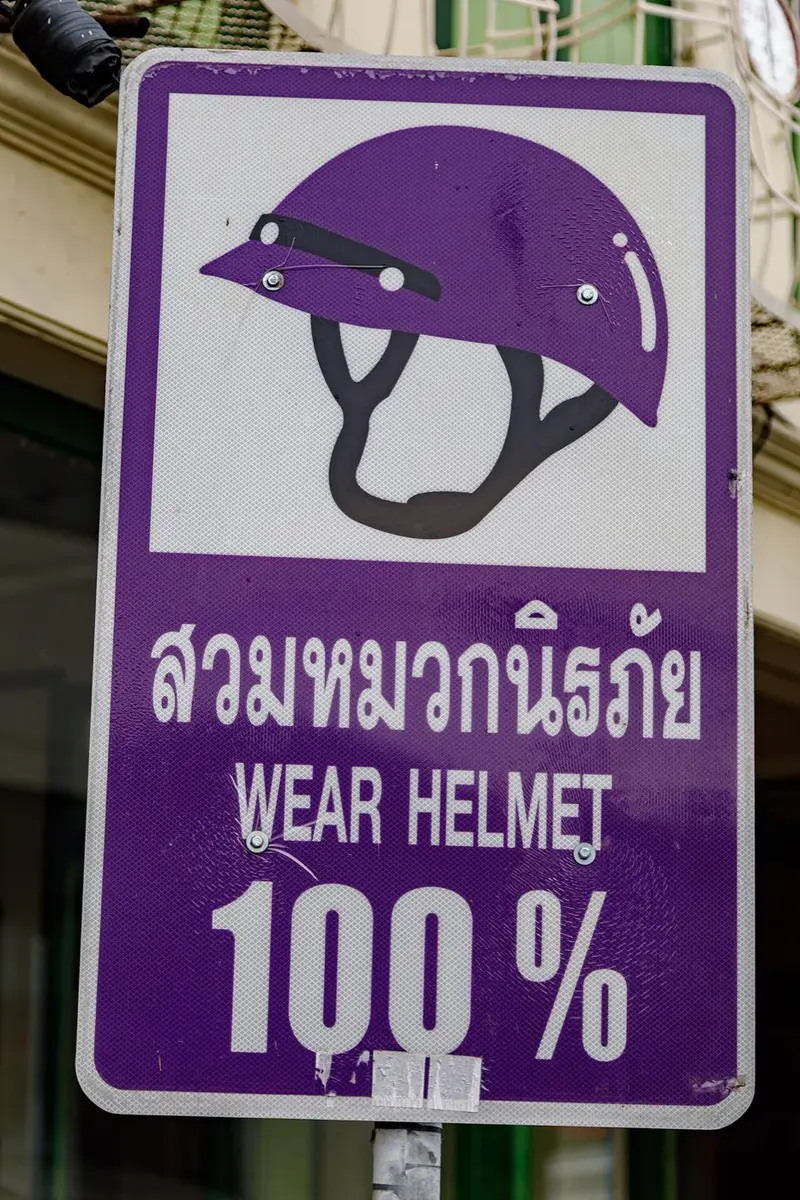
Helmets. Section 122 requires both the rider and the passenger to wear a helmet, and bans riders from carrying a passenger without one. No helmet means a fine of up to 2,000 baht (Section 148). Press reports citing a government statement say a rider whose passenger has no helmet is fined double, but we did not find that rule in the text of the law, so plan on 2,000 baht. The only exemption is for monks and people who cover their head for religious reasons.
Seat belts. Since 5 September 2022, when Amendment No. 13 to the Act (B.E. 2565) took effect, the driver and every passenger in every row must buckle up, including in the back of a taxi (Section 123). The fine is up to 2,000 baht. No more than two passengers may sit in the front (Section 123/2). Rear passengers in songthaews, pickup beds and buses without belts are exempt, but then the driver must not exceed 80 km/h (Section 123/1).
Children. Section 123 has two separate rules. A child up to 6 years old must ride in a child seat or special seat. Any passenger up to 135 cm tall, in any row, must wear a belt or be protected some other way. The Royal Thai Police set the standards for child seats by announcement. The police summary from 2022 says the child seat rule would apply once that announcement was published; we could not find its text in the law database, so use a child seat regardless. Order one with your rental car, as ride-hailing cars rarely have them; see our guide to renting a car in Phuket.
Phones at the wheel
Section 43 (9) bans using a phone while driving if you have to hold it. Under a 2022 police announcement you may use a headset, hands-free or a phone in a dashboard mount; to pick it up you must stop somewhere safe. There is a fine under the law; the amount is reported differently (400-1,000 baht in older reports, up to 4,000 baht in newer ones), so check the current regulation before you travel.
Speed limits
The general limits come from a 2021 ministerial regulation in force since 21 July 2022. Signs can set a lower limit, and then the sign applies.
| Where | Car | Motorbike under 400 cc | Motorbike 400 cc or 35 kW and up |
|---|---|---|---|
| Bangkok, Pattaya, towns and communities | 80 km/h | 60 km/h | 80 km/h |
| Outside towns | 90 km/h | 70 km/h | 90 km/h |
| Outside towns, 2+ lanes each way with a median | 100 km/h | 80 km/h | 100 km/h |
| Highways designated by the Department of Highways | 120 km/h | 80 km/h | 110 km/h |
The 120 km/h limit applies only to sections the Director of Highways has designated under a separate regulation: two or more lanes each way, a solid barrier median and no at-grade U-turns. On those roads you may not drive slower than 100 km/h in the far-right lane. Trucks over 2.2 tonnes have lower limits, 60 km/h in towns. Speeding is a fine of up to 4,000 baht (Section 152).
Drink driving
Under the 2024 ministerial regulation a driver counts as drunk above 50 mg of alcohol per 100 ml of blood (0.05%). A stricter limit, above 20 mg (0.02%), applies to four groups:
- Drivers under 20
- Drivers on a provisional licence, the kind new drivers get first
- Drivers on a licence for a vehicle type that does not cover the one they drive, such as a car licence on a scooter
- Drivers with no licence, or a suspended or revoked one
The last two lines matter for tourists riding without category A: a single beer can take them over the limit. Testing is by breath, or if that is impossible by urine or blood with the driver’s consent. Refusing a test without good reason is presumed to mean you were drunk (Section 142).
The penalty under Section 160 ter is up to 1 year in prison and/or a fine of 5,000-20,000 baht (the court may impose both), plus a licence suspension of at least 6 months. It cannot be settled with a roadside ticket: the driver is handed to an investigating officer within 6 hours (Section 43 quater). If a drunk driver injures someone, the penalty is 1-5 years and 20,000-100,000 baht; for grievous harm 2-6 years and 40,000-120,000 baht; for a death 3-10 years, 60,000-200,000 baht and loss of the licence. A repeat offence within 2 years brings up to 2 years and a 50,000-100,000 baht fine, and the court must impose both prison and a fine (Sections 160 ter/1 and ter/3). Driving drunk without a licence raises the penalty by a third (Section 160 ter/2).
Demerit points
Since 9 January 2023 every licence holder has 12 points. Offences take points off: 1 for no helmet or seat belt, speeding, failing to stop for pedestrians and phone use; 2 for a red light or driving against traffic; 3 for leaving the scene of a crash; 4 for drink or drug driving and street racing (Royal Thai Police summary). At zero the licence is suspended for 90 days (Section 142/1), and driving during that time risks up to 3 months in prison or a fine of up to 10,000 baht (Section 156). Points can be restored by taking a DLT course and test.
Traffic fines table
The figures are the legal maximums. The officer sets the actual amount on the ticket from a scale approved by the Royal Thai Police.
| Offence | Penalty under the law | Section | Source |
|---|---|---|---|
| Speeding | fine up to 4,000 baht | Land Traffic Act s. 67 and 152 | legal text, OCS |
| Running a red light | fine up to 4,000 baht | s. 22 and 152 | legal text, OCS |
| Not stopping for pedestrians at a crossing | fine up to 4,000 baht | s. 21 and 152 | police summary 2022 |
| Holding a phone while driving | a fine under the law, check the current amount | s. 43 (9) | legal text, OCS |
| Reckless driving | fine up to 4,000 baht | s. 43 (4) and 157 | legal text, OCS |
| Driving on the wrong side | fine up to 2,000 baht | s. 33 and 151 | legal text, OCS |
| No helmet, rider or passenger | fine up to 2,000 baht | s. 122 and 148 | legal text, OCS |
| No seat belt | fine up to 2,000 baht | s. 123 and 148 | legal text, OCS |
| Driving without a licence | up to 1 month or fine up to 1,000 baht | Motor Vehicle Act s. 42 and 64 | legal text, OCS |
| Licence not carried | fine up to 1,000 baht | Motor Vehicle Act s. 42 and 66 | legal text, OCS |
| Driving with no regard for others’ safety | up to 1 year or 5,000-20,000 baht | s. 43 (8) and 158/1 | legal text, OCS |
| Drink driving, first offence | up to 1 year and/or 5,000-20,000 baht | s. 43 (2) and 160 ter | legal text, OCS |
| Drink driving again within 2 years | up to 2 years and 50,000-100,000 baht | s. 160 ter/1 | legal text, OCS |
| Leaving the scene of a crash | up to 3 months or 2,000-10,000 baht | s. 78 and 160 | legal text, OCS |
| Driving while suspended | up to 3 months or up to 10,000 baht | s. 156 | legal text, OCS |
Fine-only offences in these laws became administrative fines (kha prap pen phinai) under the Act on Administrative Fines B.E. 2565 (2022), Section 39, with the amounts unchanged.
Police checkpoints: what to show and how to pay
An officer may stop a vehicle when they see an offence and order an alcohol test (Section 142). Show your licence, your IDP if you have one, and the copy of the registration book. Keep your passport or a copy on you.
The officer can give a warning or write a ticket (bai sang, Section 140). If the driver is in no state to continue safely, the officer may hold the licence temporarily (Section 140/2). Section 141 says a ticket is paid through the channels printed on it or at a police station, after which the case is closed. Krungthai Bank takes PTM-marked tickets at branches (20 baht fee), ATMs (15 baht), the Krungthai NEXT and Paotang apps (free), Boonterm and CenPay kiosks (20 baht) and Thailand Post (15 baht), as of October 2026. Unpaid tickets can be checked at ptm.police.go.th/eTicket.
To avoid an informal on-the-spot payment, ask for the ticket, pay it at a bank or police station and keep the receipt. If someone wants cash without a ticket or something feels off, call the tourist police on 1155, where operators speak English. Other tricks visitors run into are covered in scams in Phuket.
If you have an accident
Section 78 requires anyone involved in a crash that harms people or someone else’s property to stop, help and report to the police, even if it was not their fault. A driver who flees is presumed to be at fault and the vehicle can be seized. Step by step:
- Stop, switch on hazard lights and put out a warning triangle or ask someone to warn other traffic
- If anyone is hurt, call an ambulance on 1669 and do not move them unless they are in danger where they are
- Call the police on 191 or the tourist police on 1155
- Give the other party your name, address and plate number, as Section 78 requires
- Photograph the vehicles, plates, road and the other driver’s documents
- Call the rental company or your insurer before signing anything
- Claim on the compulsory insurance within 180 days (Section 27 of the 1992 Act)
The emergency numbers are those listed in the Government of Canada’s travel advice: police 191, tourist police 1155, ambulance 1669, fire 199.
Compulsory insurance (por ror bor)
Every car and motorbike in Thailand must carry compulsory insurance under the Protection for Motor Vehicle Accident Victims Act 1992 (Section 7); an uninsured owner faces a fine of up to 10,000 baht (Section 37). It pays for injuries to people, not repairs. Amounts under the 2025 OIC policy form:
| Payment per person | Amount |
|---|---|
| Medical costs paid upfront regardless of fault | up to 30,000 baht |
| Death or permanent disability, upfront regardless of fault | 35,000 baht |
| Total medical costs if the other driver is at fault | up to 80,000 baht |
| Death or total permanent disability | 500,000 baht |
| Permanent disability or loss of a limb | 200,000-500,000 baht |
| Inpatient daily allowance | 200 baht a day, up to 20 days |
| Cap | 504,000 baht per person and 20 million baht per accident |
If the injured person is the driver of the insured vehicle, they receive only the upfront payment, up to 30,000 baht for medical costs. Repairs and damage to other people’s property are covered by voluntary insurance, sold in classes, with first class (prakan chan 1) the most complete. Rental scooters often have none, so ask before you rent.
Travel insurance and riding without a licence
The Canadian and UK governments both warn that insurers may refuse a claim if you were driving without a valid licence for that vehicle. Many policies require you to hold the same category at home. Before you travel, check the exclusions for motorbikes, licence category, helmets and alcohol. If you only need a scooter to get to the beach, a ride-hailing car can be simpler; prices and tips are in our Phuket taxi guide.
This page is reviewed every 90 days.
FAQ
Do I need an International Driving Permit in Thailand, and which one?
Yes, carry an IDP with your own licence: it shows police and insurers that you hold the category. Thailand is party to both conventions: Geneva 1949 since 1962 and Vienna 1968 (ratified 1 May 2020, in force for Thailand since 1 May 2021; UN data). If your country is a Vienna party, get the 1968 IDP; the UK government, for example, now tells British drivers to carry the 1968 version with their UK licence. If your country is only in the Geneva convention, as the US is, the 1949 IDP is the one Thailand recognises. Advice that only the 1949 IDP works dates from before 1 May 2021.
What happens if I ride a scooter without a licence?
Under Section 64 of the Motor Vehicle Act, driving without a licence carries a fine of up to 1,000 baht or up to 1 month in prison. Having a licence but not carrying it is a fine of up to 1,000 baht under Section 66. The bigger risk is insurance refusing to pay after a crash, and an unlicensed rider faces an alcohol limit 2.5 times stricter, 20 mg instead of 50 mg per 100 ml of blood.
Can I pay a traffic fine to the officer on the spot?
Section 141 says a ticket (bai sang) is paid through the official channels printed on it or at a police station. Krungthai Bank takes these fines at branches, ATMs, the Krungthai NEXT and Paotang apps and Thailand Post offices. Ask for the ticket and a receipt, and call the tourist police on 1155 if something feels wrong.
Does a scooter passenger need a helmet, including on a motorbike taxi?
Yes. Section 122 requires both rider and passenger to wear a helmet, and the rider may not carry a passenger without one. The fine is up to 2,000 baht (Section 148). That applies to motorbike taxis too.
Do I have to wear a seat belt in the back of a taxi?
Yes. Since 5 September 2022 Section 123 requires every passenger in every row to buckle up, with a fine of up to 2,000 baht. Songthaews, pickups and buses without belts are exempt for rear passengers, but then the driver must stay at or below 80 km/h (Section 123/1).
Do demerit points apply to foreigners?
Points are tied to driving licences: since 9 January 2023 every licence holder has 12 points, and at zero the licence is suspended for 90 days (Section 142/1). The official sources we found do not say how points are recorded against foreign licences. If you hold a Thai licence, points come off like anyone else's.
How much can I drink and drive in Thailand?
A driver counts as drunk above 50 mg of alcohol per 100 ml of blood (0.05%). For drivers under 20, on a provisional licence, on a licence for a vehicle type that does not cover the one they drive, without a licence, or with a suspended or revoked licence, the limit is 20 mg (0.02%) under the 2024 regulation (clause 6(1)). The safe choice is not to drink at all: refusing the test is presumed to mean you were drunk.
Sources
- Land Traffic Act B.E. 2522 (1979), current consolidated Thai text, Office of the Council of State
- Motor Vehicle Act B.E. 2522 (1979), consolidated Thai text, OCS
- Ministerial regulation on speed limits on roads, 2021 (Royal Gazette vol. 138, 77 Kor, 23 Nov 2021), OCS
- Ministerial regulation on speed limits on designated highways, 2021 (Royal Gazette vol. 138, 17 Kor, 10 Mar 2021), OCS
- Ministerial regulation on alcohol testing of drivers, 2024 (Royal Gazette vol. 141, 57 Kor, 20 Sep 2024), OCS
- Protection for Motor Vehicle Accident Victims Act B.E. 2535 (1992), text on the OIC website
- Office of Insurance Commission (OIC). 2025 registrar order on the compulsory motor insurance policy form
- Royal Thai Police. Summary of Amendment No. 13 (2022) and the demerit point system, file on the Department of Disaster Prevention website
- UN Treaty Collection. Convention on Road Traffic, Vienna 1968 (status and Thailand's declarations)
- UN Treaty Collection. Convention on Road Traffic, Geneva 1949 (status)
- Department of Land Transport (DLT). Applying for a provisional licence, documents for foreigners
- Krungthai Bank. Paying traffic fines: channels and fees
- GOV.UK. Thailand travel advice: safety and security (driving, 1968 IDP)
- Government of Canada. Travel advice for Thailand (emergency numbers, driving)
Found an error or outdated fact? Tell the editors, we will fix it and update the check date.